
Lone Mountain
Water Damage Restoration in Lone Mountain
Nevada Water Damage handles extraction, structural drying and repair for Lone Mountain homes, day or night, from a burst supply line to a slow roof leak. Every job starts with a free inspection, we are an IICRC-certified firm, and we bill most major insurance companies directly.
Lone Mountain
Water Damage Restoration in Lone Mountain
Lone Mountain sits northwest of our Valley View Blvd office, and its housing is older than much of the surrounding northwest valley: U.S. Census Bureau, ACS 2023 5-year data puts 58 percent of the roughly 21,941 homes in the area's ZIP code (89129) at pre-2000 construction, with the 1990s the decade that built more of Lone Mountain than any other. That share of aging stock matters for water damage specifically, because a supply line, water heater or fitting installed before 2000 has had two or three decades to work against the valley's very hard water before it ever fails.
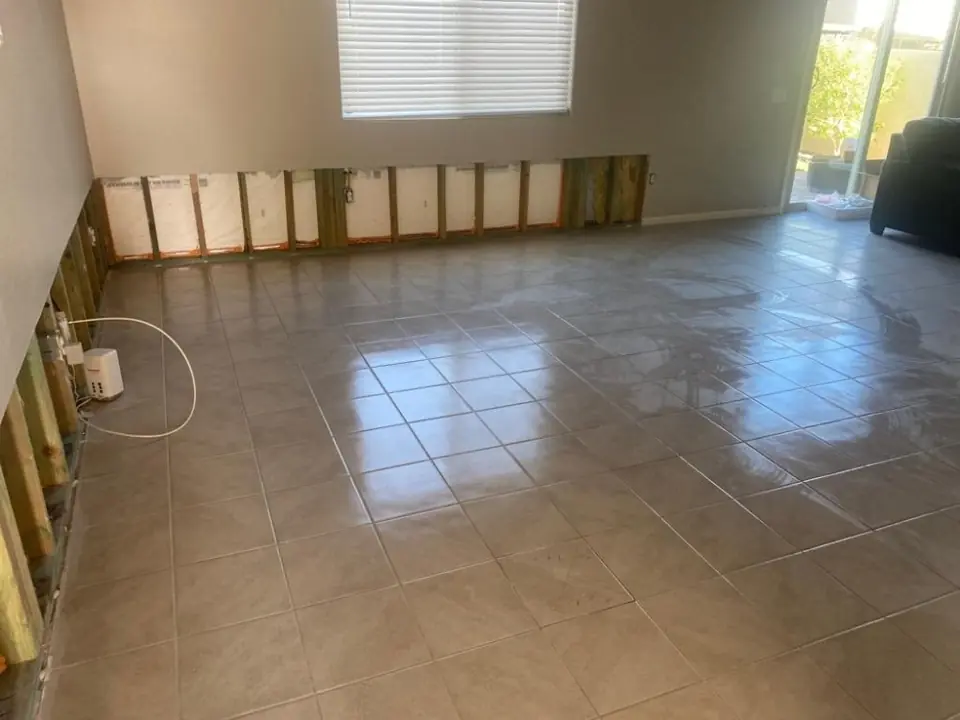
When we get called to a Lone Mountain home, the first hours usually start the same way regardless of the source: shut off the water, identify whether it is a clean supply line, a grey-water appliance discharge or something worse, and get extraction equipment on the standing water before it spreads further into flooring, cabinets or drywall. In an established neighborhood like this, a slab leak or a water heater failure in the garage can go unnoticed longer than in a newer home, since original plumbing runs are not always where a homeowner expects.
With about 70 percent of Lone Mountain households owner-occupied, most of our calls here are with the homeowner directly rather than a property manager, and long-tenured owners often want a full explanation of why a fitting failed and how to prevent a repeat. We walk through that with the moisture readings in hand, not just a verbal assurance, and we document the source and category of water from the first visit so your insurer has what it needs. Those figures describe ZIP code 89129, which includes Lone Mountain, rather than the community by itself.
Process
How we handle it in Lone Mountain
Emergency call and dispatch
You call us any hour of the day and we dispatch a crew right away, typically arriving in about an hour across most of the valley depending on your location and conditions. We ask a few quick questions so the crew shows up with the right equipment for the type of water and the size of the area.
Inspection and water category assessment
We identify the source, stop it if it is still active, and classify the water using the IICRC categories, clean supply-line water, grey water from an appliance, or contaminated black water, because that classification changes what has to be removed versus dried.
Extraction
Truck-mounted and portable extraction equipment removes standing water from floors, carpet and padding. The faster the water is out, the more flooring, drywall and framing we are usually able to save instead of removing.
Containment and moisture mapping
We use moisture meters and thermal imaging to map exactly how far the water traveled, including under flooring and inside walls, so drying equipment is placed where it is actually needed rather than guessing.
Structural drying
Industrial air movers and LGR dehumidifiers dry the affected structure over roughly three to five days on average, with daily moisture readings so we know when the materials are actually back to a normal, dry state, not just when it looks dry.
Antimicrobial treatment
Because mold can begin growing within 24 to 48 hours of water exposure, we treat affected areas with an antimicrobial to slow growth while drying is underway, and we monitor for any signs mold has already started.
Repairs and documentation
Once everything reads dry, we handle the repairs, drywall, flooring, trim and paint, and provide full documentation and photos for your insurance claim, since we bill most major insurers directly.
Lone Mountain
More services in Lone Mountain
Questions
Straight answers
How old is the typical plumbing behind a Lone Mountain water damage call?
With 58 percent of the roughly 21,941 homes in Lone Mountain's ZIP code (89129) built before 2000 (U.S. Census Bureau, ACS 2023 5-year), a lot of our calls trace back to an original supply line, an aging water heater, or a fitting that finally gave out after years of the valley's very hard water working against it. We inspect those areas closely even when the visible damage looks minor.
Do you work with Lone Mountain HOAs on shared-area leaks?
Yes. Several Lone Mountain neighborhoods are HOA-governed, and when a leak involves a shared roof, irrigation line or common-area pipe, we coordinate directly with the association or its property manager in addition to the homeowner, and document who is responsible for what.
What ZIP codes do you cover in Lone Mountain?
Our regular service area includes Lone Mountain ZIP codes 89129 and 89149, with calls taken 24 hours a day. A free inspection is the starting point for every visit, and we bill most major insurers directly once the scope of the damage is documented.
24 hours, 7 days
Water where it should not be?
Call now - we tell you what to do while we are on the way, and send the crew. Or leave your details and we call you in minutes.
